Technically yes, but it’s not the same.
- 0 Posts
- 37 Comments
Joined 1 year ago
Cake day: June 15th, 2023
You are not logged in. If you use a Fediverse account that is able to follow users, you can follow this user.
Me to my new GURPS players
 5·2 months ago
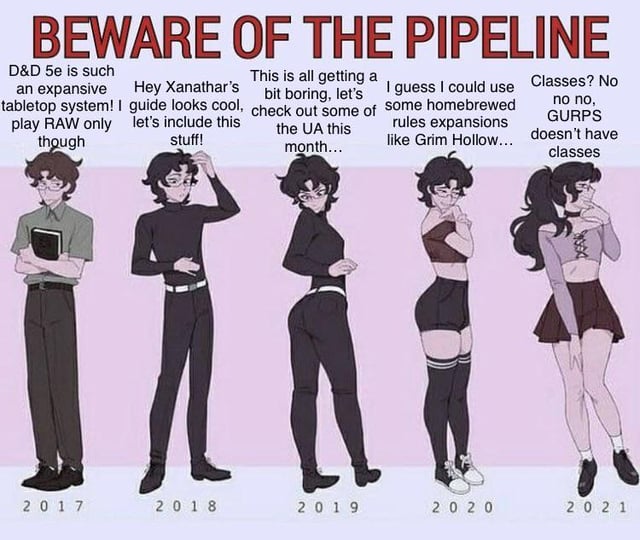
I’m this version
why can’t I make it ice ball?
As an aside, the last 5e character I played before switching was an Order of Scribes wizard, which can do exactly that.
So I regards to the difference between fireball and firebolt, you’d start off casting firebolt and you can increase it’s power until you may as well just spend that energy on the explosive attribute. Though if you didn’t want that explosive attribute you still could cast firebolt with the same energy as fireball.
You can’t though, Firebolt is a cantrip, you can’t upcast cantrips, they just get more powerful as you level up. They don’t even use spell slots, it’s just a different empowering mechanic entirely. Guess what though, what you’ve described is how it works in GURPS.
I appreciate the invitation, but I’ve already found my forever home. It’s got variable spell effects, variable magic systems, and tools to build spells, and magic systems, from scratch.
I have no trouble accepting that mana exists in quanta. What troubles me is the idea that mana clusters into meta-quanta like spell slots. Also that a spell like, say, Fireball, is totally unviable except with a specific meta-quantum of mana, at which point it does 8d6 damage.
Shouldn’t it be a simple matter to cast a weaker Fireball with less mana, or a more powerful one with more? I get that you need magic to summon fire, and a certain amount to summon 8d6-worth. But all or nothing? Why shouldn’t a 1st level slot summon 1d6 with a 5ft radius, a 2nd level slot 4d6 with a 10ft radius? One would imagine a gradient, even quantized, between Fire Bolt and Fireball.
Maybe, what’s it to ya?
It’s some kind of leveled spell joke I’m too GURPS to understand. Am I to believe that magic only works at arbitrary discrete levels? Surely any competent mage can vary the intensity of their spells with the mana they invest, no?
I play GURPS and my son is also named math
 3·4 months ago
After all the OGL drama I considered going to PF2 also, but after a little research decided if I was going to take the time to learn a new system and embrace crunch, I might as well go all the way and landed on GURPS. Got rid of all my 5e stuff and haven’t looked back
Lemme just turn my tooth into a jellyfish real quick
Is this a JoJo reference?
Pretty sure I got it, assuming the layout is roughly as I suspect. Don’t want to spoil it for everyone else though, it is clever
Idk, I think that might be a bit of an overreaction and a missed opportunity. He has a good point about being from that town and slavery being a normal part of his life growing up. That could’ve turned into an interesting in-character exploration of cultural moral standards: genuine confusion about what’s wrong with being a “good” slave-owner, maybe a conversation about how easily freed slaves are re-captured, it could turn into a whole revelation for the barb that culminates in a quest to dismantle the entire slave trade.
Obviously we’re missing some context, and it’s possible that the player exhibited problematic behavior, but personally I don’t think the scenario is itself that bad. Just sounds like a barbarian from a slave-trading society role playing their character. Some would argue that eating meat would be likewise incompatible with a good-alignment, but our culture sees no fundamental moral objection to slaughtering animals.
Spelljammer and the OGL were what drove me to GURPS.
I don’t need a book’s permission to use my imagination. I buy a book to have play tested and balanced content.
I would actually pair that with secret rolls. Every once in a while, just roll the dice behind the screen, consider the result sagely, then make no mention of it and continue as usual.
That’s just meta-meta-gaming imo. Fine if that’s your group dynamic, just not my thing. Personally, it seems like way more time and effort.
Perception stats exist for a reason, and I’d argue they’re usually incompatible with knowing the result of the roll, even with players who try not to meta-game. Even if they behave, they’re subconsciously going to know how they rolled and that will change the experience, unless you start meta-meta-gaming (changing the success window, frequently calling for rolls for nothing, etc.). Personally that seems like a pound of cure vs an ounce of prevention.
If a semi-spoiler-laden, actively counter-meta-gamed experience is what your group likes, more power to you. But more often than not, I think the GM rolling for checks where success/failure isn’t obvious preserves the experience for all players and prevents meta-gaming, both intentional and subconscious.
That is one alternative, yes. Needlessly tedious in my opinion, but that’s just my personal taste.
This sentiment is hyperbole, but still fueled my exit.